
闯关东
4,220-year-old rock art in SW China’s Yunnan reveals early cultural links with Southeast Asia_我的网站

一 |
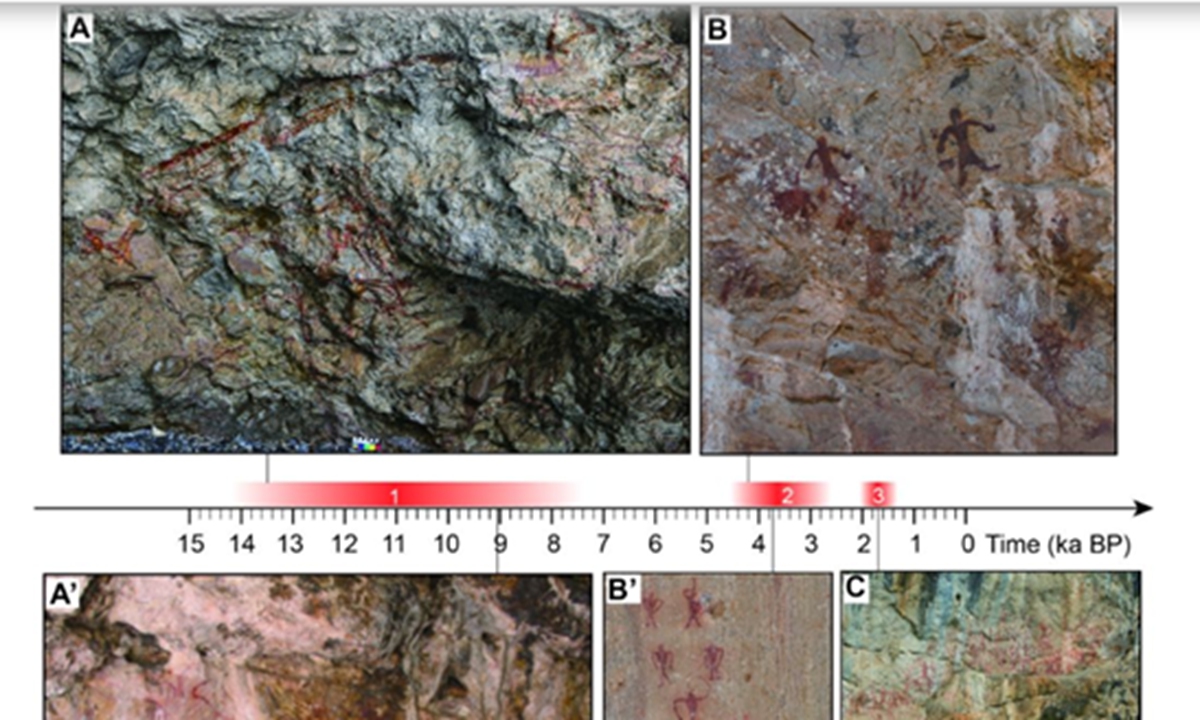
Chinese researchers have obtained the first absolute dates for rock paintings at the Mangguan rock art site in Southwest China's Yunnan Province, pushing the known history of rock art created by prehistoric settled communities in the region back to about 4,220 years ago. The paintings also suggest cultural interactions more than 4,000 years ago between Southwest China and civilizations along the Yellow and Yangtze rivers, as well as possible exchanges with neighboring parts of Southeast Asia, including present-day Myanmar, Thailand and Vietnam, a member of the research team told the Global Times.
The Yunnan Provincial Institute of Cultural Relics and Archaeology, in collaboration with Nanjing Normal University and other institutions, have recently made a significant archaeological breakthrough. Through systematic surveys and uranium-thorium (U-Th) dating at the Mangguan site in Gengma county, the research team obtained the first absolute dates for the site's rock paintings, tracing rock art created by prehistoric settled communities back to around 4,220 years ago.
The findings were recently published in the international journal Journal of Archaeological Science: Reports.
The Mangguan rock paintings represent one of the best-preserved prehistoric rock art sites in Yunnan. The research team presented high precision U Th dating of carbonate accretions that stratigraphically overlie the painted motifs at the Mangguan site, according to the paper published in the journal.
The dating results show that carbonate deposits overlying a human figure yielded a corrected age of 4,240 ± 19 years before present, confirming that ancient people living in the region had already produced mature figurative art at least 4,220 years ago, Wu Yun, first author of the paper and an associate researcher at the Yunnan Provincial Institute of Cultural Relics and Archaeology, was cited by the Xinhua News Agency report as saying.
Dating results from 11 samples taken from different motifs clustered between about 3,907 and 3,056 years ago. By comparison, the Cangyuan cliff paintings had previously been dated to roughly 3,800 to 2,700 years ago. The Mangguan paintings are therefore significantly older, filling an important chronological gap in the region's artistic record before the Cangyuan phase.
Shao Qingfeng, corresponding author of the paper and a professor at the School of Geography at Nanjing Normal University, told the Global Times that previous estimates dated the Mangguan rock paintings to a little over 3,000 years ago based mainly on imagery and comparisons with similar regional sites. Using microsamples of secondary carbonate deposits overlying the paintings, researchers have now obtained a precise minimum age of about 4,220 years before present without damaging the rock art.
The findings and the establishment of this chronological framework not only strengthen the archaeological foundation for studying rock art in Southwest China, but also provide a direct reference for rock art sites across Southeast Asia that have yet to undergo systematic dating, Shao said.
The findings may also challenge long-held perceptions of Southwest China around 4,200 years ago - roughly the era of the Xia Dynasty (c.2070 BC-C.1600 BC) - and help fill a key gap in understanding the pluralistic yet integrated development of Chinese civilization.
Shao said that while academic research has traditionally focused on the Yellow River and Yangtze River basins as cradles of early Chinese civilization, sites such as Mangguan and Cangyuan show that stable and culturally active communities also thrived in mountainous Southwest China. The newly established rock-art chronology brings an artistic dimension to the broader narrative of China's enduring cultural development.
Moreover, stylistic similarities suggest that Southwest China maintained exchanges with the Yellow River and Yangtze River regions and with early societies in Southeast Asia, providing material evidence of cross-regional interaction more than 4,000 years ago.
。 8月14日,八马上市后全产业链布局再下一城——云南八马茶业信记号超级工厂项目签约仪式在深圳举办,第九代智能生产线正式落地“中国普洱茶第一县”勐海。作为传承三百年的制茶世家,八马茶业上市后始终坚守老字号发展本源,以科技创新为传统制茶赋能,让勐海超万棵古茶树资源在标准化生产体系中焕发全新生命力。
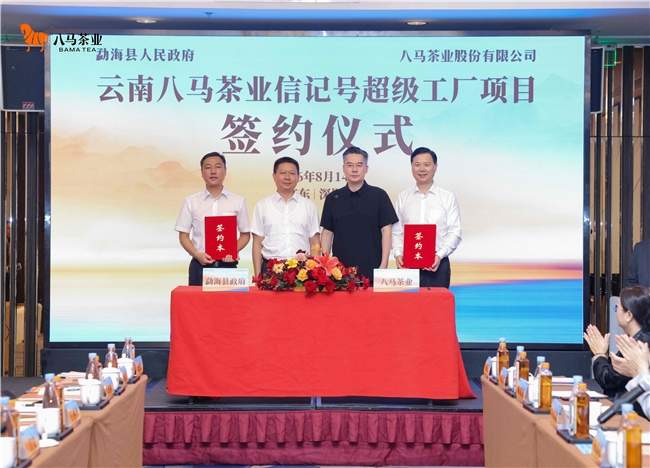 西双版纳州、县两级政府代表团专程赴深出席签约仪式,与八马茶业核心管理层共同见证项目落地。根据规划,八马将在勐海135亩工业用地上建设普洱茶超级工厂,搭载第九代智能生产线,配套研发、检测、仓储中心。目前项目前期筹备工作已全面启动,计划于2026年底前开工建设。 八马茶业作为三百年制茶世家,总部扎根深圳罗湖,多年稳居行业龙头地位。旗下信记号作为深圳首批中华老字号茶品牌,早已在勐海深耕多年,坐拥超万棵古茶树资源,曾连续多年独家获得老班章、冰岛茶王树采摘权,积淀了深厚的原产地原料优势与老字号品牌底蕴。
二 | 上市之后,八马并未脱离制茶本源,反而以更坚定的长期主义深耕核心产区,延续从安溪、武夷山到勐海的原产地布局脉络。 此次勐海超级工厂的第九代智能生产线,是八马“六大超级工程”的核心落地成果。

三 | 此前安溪第六代、武夷山一期第七代超级工厂已顺利投产,武夷山二期第八代生产线同步推进;距年中战略发布会仅八天,勐海第九代生产线便完成签约,跑出了上市企业的落地加速度。数智化改造并非对传统制茶的替代,而是通过全链路智能生产与品控体系,锁住古茶树原料的风味本真,让优质普洱茶突破手工产能的局限,以稳定品质走向更广阔的市场,推动勐海茶产业从“原料输出”向“品牌智造”转型。

四 |  作为连续13年入选的农业产业化国家重点龙头企业,八马上市后持续将深圳成熟的品牌运营与标准管理能力反向赋能传统茶产区。

五 | 截至2025年末,勐海拥有90.59万亩茶园,茶产业综合产值突破350亿元,带动全县26万茶农稳定增收。

六 | 此次政企强强联合,不仅将助力云茶产业实现生产数智化、产品标准化、品牌化、国际化的全面跃升,更将探索茶文旅、茶研学等融合业态。从三百年制茶技艺的代代相传,到第九代智能生产线的落地生根,传统底蕴与前沿科技在勐海茶山完成深度碰撞。八马上市后正以“守根+创新”的清晰路径,让老字号品牌持续焕发新生,稳步向着从中国第一迈向世界第一的长期目标前行。【广告】免责声明:本内容为广告,相关素材由广告主提供,本文仅代表作者个人观点,与本网无关。本网发布目的在于传递更多信息,并不代表本网赞同其观点和对其真实性负责,广告内容仅供读者参考,请自行核实相关内容。

七 |
Current article:http://u78by05.yinkataizengquge.bond/iu0/e99.html
Published on:18:32:57